Showing posts with label storage costs. Show all posts

Thursday, July 30, 2026

Microsoft's Project Silica

2021 Media Shipments

Exabytes Revenue $/GB
Flash598$68.6B$0.115
Hard Disk1418$28.0B$0.020
LTO Tape59.2$0.51B$0.003
I summed up my big picture view of archival media eight years ago in Archival Media: Not a Good Business. Whatever your choice of technology, the economics are brutal. This is a version of the table in that post, updated to 2021 and again based upon IBM data. Note that archival media shiped 4% as many bytes as hard disk and generated 1.8% or the revenue. It remains a tiny market.

I have written several times about Microsoft Research's Project Silica, most recently in last year's Archival Storage:
I'm skeptical of "commoditizing the technology". Archival systems are a niche in the IT market, and one on which companies are loath to spend money. Realistically, there aren't going to be a vast number of Silica write heads. The only customers for systems like Silica are the large cloud providers, who will be reluctant to commit their archives to technology owned by a competitor. Unless a mass-market application for femtosecond lasers emerges, the scope for cost reduction is limited.

But the more I think about this technology, which is still in the lab, the more I think it probably has the best chance of impacting the market among all the rival archival storage technologies. Not great, but better than its competitors:
I followed this with a list of eight major reasons for my opinion.

Below the fold an update on the project and an assessment.

Tuesday, June 9, 2026

Library of Congress Storage Architecture Meeting 2026

Once again I attended most of the library of Congress' Designing Storage Architectures workshop remotely. I apologize for the delay in posting this; domestic duties have kept me very busy recently. Below the fold notes on the talks that caught my attention, based on my now somewhat memory and the slide decks for the talks from the Library of Congress website.

Tuesday, January 20, 2026

Internet Archive's Storage

Internet Archive Staff
Bruce Li introduces his The Long Now of the Web: Inside the Internet Archive’s Fight Against Forgetting thus:
This report delves into the mechanics of the Internet Archive with the precision of a teardown. We will strip back the chassis to examine the custom-built PetaBox servers that heat the building without air conditioning. We will trace the evolution of the web crawlers—from the early tape-based dumps of Alexa Internet to the sophisticated browser-based bots of 2025. We will analyze the financial ledger of this non-profit giant, exploring how it survives on a budget that is a rounding error for its Silicon Valley neighbors. And finally, we will look to the future, where the "Decentralized Web" (DWeb) promises to fragment the Archive into a million pieces to ensure it can never be destroyed.
It is long, detailed, comprehensive and well worth reading in full. Below the fold I comment on the part about storage.

Thursday, September 18, 2025

Hard Disk Unexpectedly Not Dead

As I read Zak Killian's Expect HDD, SSD shortages as AI rewrites the rules of storage hierarchy — multiple companies announce price hikes, too I realized I had forgotten to write this year's version of my annual post on the Library of Congress' Desihning Storage Architectures meeting, which was back in March. So below the fold I discuss a few of the DSA talks, Killian's more recent post, and yet another development in DNA storage. The TL;DR is that the long-predicted death of hard disks is continuing to fail to materialize, and so is the equally long-predicted death of tape.

Friday, March 14, 2025

Archival Storage

I gave a talk at the Berkeley I-school's Information Access Seminar entitled Archival Storage. Below the fold is the text of the talk with links to the sources and the slides (with yellow background).

Friday, July 8, 2022

Economic Model Revived

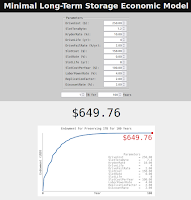
Five years ago, at the urging of the Internet Archive, I implemented a simple interactive version of the Economic Model of Long-Term Storage in Python. It estimated the endowment needed to store a Terabyte for 100 years based on a set of parameters that people could vary. It ran on a Raspberry Pi at the end of our Sonic DSL home Internet connection. The endowment is the capital which, together with the interest it earns, is enough to cover the costs incurred stoing the data for the century.

Alas, the Pi became a casualty when, early in the pandemic, we upgraded to the wonderful Sonic gigabit fiber (Best ISP Evah!), needed to support multiple grandkids each in a different virtual school.

Fortunately, Sawood Alam at the Internet Archive has forked the code, re-implemented it in Javascript, improved the user interface, and deployed it at Github. This new version is once again available here. I'm very grateful to Sawood and the team at the Internet Archive, both for pushing me to do the initial implementation, and now for bringing it back from the dead.

Below the fold I have a couple of caveats.

Thursday, March 25, 2021

Internet Archive Storage

The Internet Archive is a remarkable institution, which has become increasingly important during the pandemic. It has been for many years in the world's top 300 Web sites and is currently ranked #209, sustaining almost 60Gb/s outbound bandwidth from its collection of almost half a trillion archived Web pages and much other content. It does this on a budget of under $20M/yr, yet maintains 99.98% availability.

Jonah Edwards, who runs the Core Infrastructure team, gave a presentation on the Internet Archive's storage infrastructure to the Archive's staff. Below the fold, some details and commentary.

Friday, May 15, 2020

Economics Of Decentralized Storage

Almost two years ago, in The Four Most Expensive Words in the English Language , I wrote skeptically about the economics of decentralized storage networks. I followed up two months later with The Triumph Of Greed Over Arithmetic. Now, Got a few spare terabytes of storage sitting around unused? Tardigrade can turn that into crypto-bucks is Thomas Claiburn's report on initial experience with Tardigrade, the "decentralized" storage network from Storj Labs. Below the fold, some more skepticism.

Tuesday, March 31, 2020

Archival Cloud Storage Pricing

Although there are significant technological risks to data stored for the long term, its most important vulnerability is to interruptions in the money supply. The current pandemic is likely to cause archives to suffer significant interruptions in the money supply.

In Cloud For Preservation I described how much of the motivation for using cloud services was their month-by-month pay-for-what-you-use billing, which transforms capital expenditures (CapEx) into operational expenditures (OpEx). Organizations typically find OpEx much easier to justify than CapEx because:
  • The numbers they look at are smaller, even if what they add up to over time is greater.
  • OpEx is less of a commitment, since it can be decreased if circumstances change.
Unfortunately, the lower the commitment the higher the risk to long-term preservation. Since it doesn't deliver immediate returns, it is likely to be first on the chopping block. Thus both reducing storage cost and increasing its predictability are important for sustainable digital preservation. Below the fold I revisit this issue.

Tuesday, September 24, 2019

Promising New Hard Disk Technology

It has been too long, two-and-a-half years, since the last of Tom Coughlin's Storage Valley Supper Club events. But he just organized one to coincide with the Flash Memory Summit. It featured an extremely interesting talk by Karim Kaddeche, CEO of L2 Drive, a company whose technology seems likely to have a big impact on the hard disk market. Follow me below the fold for the explanation. I didn't take notes, so what follows is from memory. I apologize for any errors.

Thursday, August 29, 2019

SSD vs. HDD (Updated)

IDC & TrendForce data
via Aaron Rakers
Chris Mellor's How long before SSDs replace nearline disk drives? starts with a quote I think the good Dr. Pangloss would love:
Aaron Rakers, the Wells Fargo analyst, thinks enterprise storage buyers will start to prefer SSDs when prices fall to five times or less that of hard disk drives. They are cheaper to operate than disk drives, needing less power and cooling, and are much faster to access.
Below the fold, some skepticism.

Thursday, May 16, 2019

Review Of Data Storage In DNA

Luis Ceze, Jeff Nivala and Karin Strauss of the University of Washington and Microsoft Research team have published a fascinating review of the history and state-of-the-art in Molecular digital data storage using DNA. The abstract reads:
Molecular data storage is an attractive alternative for dense and durable information storage, which is sorely needed to deal with the growing gap between information production and the ability to store data. DNA is a clear example of effective archival data storage in molecular form. In this Review , we provide an overview of the process, the state of the art in this area and challenges for mainstream adoption. We also survey the field of in vivo molecular memory systems that record and store information within the DNA of living cells, which, together with in vitro DNA data storage, lie at the growing intersection of computer systems and biotechnology.
They include a comprehensive bibliography. Below the fold, some commentary and a few quibbles.

Thursday, May 2, 2019

Lets Put Our Money Where Our Ethics Are

I found a video of Jefferson Bailey's talk at the Ethics of Archiving the Web conference from a year ago. It was entitled Lets Put Our Money Where Our Ethics Are. The talk is the first 18.5 minutes of this video. It focused on the paucity of resources devoted to archiving the huge proportion of our culture that now lives on the evanescent Web. I've also written on this topic, for example in Pt. 2 of The Amnesiac Civilization. Below the fold, some detailed numbers (that may by now be somewhat out-of-date) and their implications.

Thursday, March 21, 2019

Cost-Reducing Writing DNA Data

In DNA's Niche in the Storage Market, I addressed a hypothetical DNA storage company's engineers and posed this challenge:
increase the speed of synthesis by a factor of a quarter of a trillion, while reducing the cost by a factor of fifty trillion, in less than 10 years while spending no more than $24M/yr.
Now, a company called Catalog plans to demo a significant step in the right direction:
The goal of the demonstration, says Park, is to store 125 gigabytes, ... in 24 hours, on less than 1 cubic centimeter of DNA. And to do it for $7,000.
That would be 1E11 bits for $7E3. At the theoretical maximum 2 bits/base, it would be $3.5E-8 per base, versus last year's estimate of 1E-4, or around 30,000 times better.

If the demo succeeds, it marks a major achievement. But below the fold I continue to throw cold water on the medium-term prospects for DNA storage.

Tuesday, March 5, 2019

Demand Is Far From Insatiable

Based on numbers that IDC conjures from thin air, pundits believe that demand for storage is insatiable because everyone says Lets Just Keep Everything Forever In The Cloud. That idea assumes storage is free, but Storage Will Be Much Less Free Than It Used To Be. (Both links are from 2012). Below the fold I look at some real-world numbers showing how much storage actual customers are buying.

Tuesday, February 26, 2019

Economic Models Of Long-Term Storage

My work on the economics of long-term storage with students at the UC Santa Cruz Center for Research in Storage Systems stopped about six years ago some time after the funding from the Library of Congress ran out. Last year to help with some work at the Internet Archive I developed a much simplified economic model, which runs on a Raspberry Pi.

Two recent developments provide alternative models:
  • Last year, James Byron, Darrell Long, and Ethan Miller's Using Simulation to Design Scalable and Cost-Efficient Archival Storage Systems (also here) reported on a vastly more sophisticated model developed at the Center. It includes both much more detailed historical data about, for example, electricity cost, and covers various media types including tape, optical, and SSDs.
  • At the recent PASIG Julian Morley reported on the model being used at the Stanford Digital Repository, a hybrid local and cloud system, and he has made the spreadsheet available for use.
Below the fold some commentary on all three models.

Thursday, November 8, 2018

What's Happening To Storage?

My only post about storage since May, was October's Betteridge's Law Violation, another critique of IDC's Digital Universe, and their constant pushing of the idea that the demand for storage is insatiable. So its time for an update on what is happening in the real world of storage media, instead of IDC's Universe. Below the fold, some quick takes.

Tuesday, November 6, 2018

Making PIEs Is Hard

In The Four Most Expensive Words In The English Language I wrote:
Since the key property of a cryptocurrency-based storage service is a lack of trust in the storage providers, Proofs of Space and Time are required. As Bram Cohen has pointed out, this is an extraordinarily difficult problem at the very frontier of research.
The post argues that the economics of decentralized storage services aren't viable, so the difficulty of Proofs of Space and Time isn't that important. All the same, this area of research is fascinating. Now, in One File for the Price of Three: Catching Cheating Servers in Decentralized Storage Networks Ethan Cecchetti, Ian Miers, and Ari Juels have pushed the frontier further out by inventing PIEs. Below the fold, some details.

Thursday, October 18, 2018

Betteridge's Law Violation

Erez Zadok points me to Wasim Ahmed Bhat's Is a Data-Capacity Gap Inevitable in Big Data Storage? in IEEE Computer. It is a violation of Betteridge's Law of Headlines because the answer isn't no. But what, exactly, is this gap? Follow me below the fold.