Showing posts with label ai. Show all posts

Tuesday, November 3, 2026

Pensions (Updated)

In Eating The Seed Corn I wrote about AI's destruction of entry-level jobs. But Karen Weise's Microsoft Offers Buyouts to 60,000 Employees as It Spends on A.I. reports on a different impact (my emphasis):
Microsoft on Monday offered buyouts to a quarter of its work force, the latest effort by the company to rein in costs as it spends heavily on artificial intelligence.
...
The “time-limited, voluntary” program grew out of the company’s first ever buyouts earlier this year, she wrote. In April, Microsoft offered early retirement to 8,600 long-tenured U.S. employees, and about 30 percent accepted the packages and left over the summer. Microsoft said it heard from additional employees who would have taken the buyout if they had been eligible. That informed the company’s decision to create this new, expanded program.
Microsoft expects many fewer acceptances in this new program, but the people leaving are not entry-level, they are well-paid senior staff. If the goal is to divert cash from salaries to capex getting rid of senior staff is much more effective.

Below the fold I look into the non-obvious implications of AI's impact on well-paid employees' jobs.

Tuesday, October 20, 2026

The Underpants Gnomes' Step 2 (Updated)

Source
Barry Ritholtz posted this up-and-right chart, which is a classic of exponential extrapolation. Given the difficulty, delays, and cost of bringing the current generation of data center projects on-line, highlighted by Oracle's "force majeure" on a 2.5GW project which is clearly not going to be complete next year, the idea that 4-5GW projects will be up and running in 2029 seems optimistic.

Below the fold I apply some skepticism, because this is starting to look like the classic South Park episode Gnomes:
The episode is also known for the nonsensical business plan that the gnomes of the title devise, whose three steps consist of:
  1. Collect underpants
  2. ?
  3. Profit
which later became a common meme used to mock poorly-thought-out business and political strategies.

Thursday, October 15, 2026

Dark GPUs

Laying dark fiber
Stealth Communications CC-BY-SA
Wikipedia's Dark Fibre article starts:
Dark fibre originally referred to the potential network capacity of telecommunication infrastructure. Because the marginal cost of installing additional fibre optic cables is very low once a trench has been dug or conduit laid, a great excess of fibre was installed in the US during the telecom boom of the late 1990s and early 2000s. This excess capacity was later referred to as dark fibre following the dot-com crash of the early 2000s that briefly reduced demand for high-speed data transmission.

These unused fibre optic cables later created a new market for unique private services that could not be accommodated on lit fibre cables (i.e., cables used in traditional long-distance communication).
Many are analogizing the current AI bubble to the dot-com era, pointing out that although the dark fiber eventually became very valuable infrastructure, the companies that invested in laying it suffered. Wikipedia notes that the buildout:
was based on the assumption that telecoms traffic, particularly data traffic, would continue to grow exponentially for the foreseeable future. The advent of wavelength-division multiplexing reduced the demand for fibre by increasing the capacity of a single fibre by a factor of as much as 100.

According to Gerry Butters, the former head of Lucent Technologies's Optical Networking Group at Bell Labs, the amount of data that could be carried by an optical fibre was doubling every nine months at the time. This progress in the ability to carry data over fibre reduced the need for more fibres. As a result, the wholesale price for data communications collapsed and a number of these companies filed for bankruptcy protection. Global Crossing and Worldcom are two high-profile examples in the United States.
The analogy being suggested is that the AI data centers will eventually be valuable infrastructure even if delays in construction and lack of real demand mean that the companies building them will suffer.

Below the fold I investigate this analogy.

Tuesday, October 13, 2026

Crowding Out

In Downgrades and Competition For Capital I discussed how AI's insatiable appetite for funds was raising interest rates not just for AI-related debt, but also for everyone else. The impact of these rate increases will take time to become evident, as borrowers roll over existing debt or raise new debt.

Below the fold I look at impacts that we don't have to wait for, because they are already happening on a large scale.

Thursday, September 24, 2026

Competition For Capital

Exhibit 1
The same day I posted Downgrades Peter Oppenheimer et al from Goldman Sachs (GS) weighed in on the same topic with Competition for Capital:
"There are two themes dominating our investor conversations: the impact of AI and the rise in interest rates. The two issues are linked as demand for capital from both the private and public sectors increase. In the private sector a surge in capex spending to fund AI infrastructure has eaten into free cash flow and forced companies to raise more in debt and equity markets. Meanwhile, government borrowing needs have increased as priorities shift towards upgrading critical infrastructure, energy security and defense at a time when cyclical inflationary pressures driven by higher energy prices are also resulting in higher policy rates. The combination has pushed up the cost of capital. As recently as 2022, for example, 30-year bond yields in Germany and Japan were close to zero ... A rise in yields, together with more uncertainty (over geopolitics and the future impact of AI) have, in combination, pushed up the cost of capital."
As one would expect from the professionals there is a lot to digest in their report. Below the fold I discuss the details.

Thursday, September 17, 2026

Downgrades (Updated)

10-year Treasury yield
Recently, interest rates for government debt have been rising worldwide. As I write the yield of the 10-year US treasury is over 5%. It had been below 4.5% for over a year when, in March, it started a steady rise. This is despite (and probably because of) Scott Bessent's efforts to force it lower, which JP Morgan compared to 'paying your mortgage with your credit card'.

Source
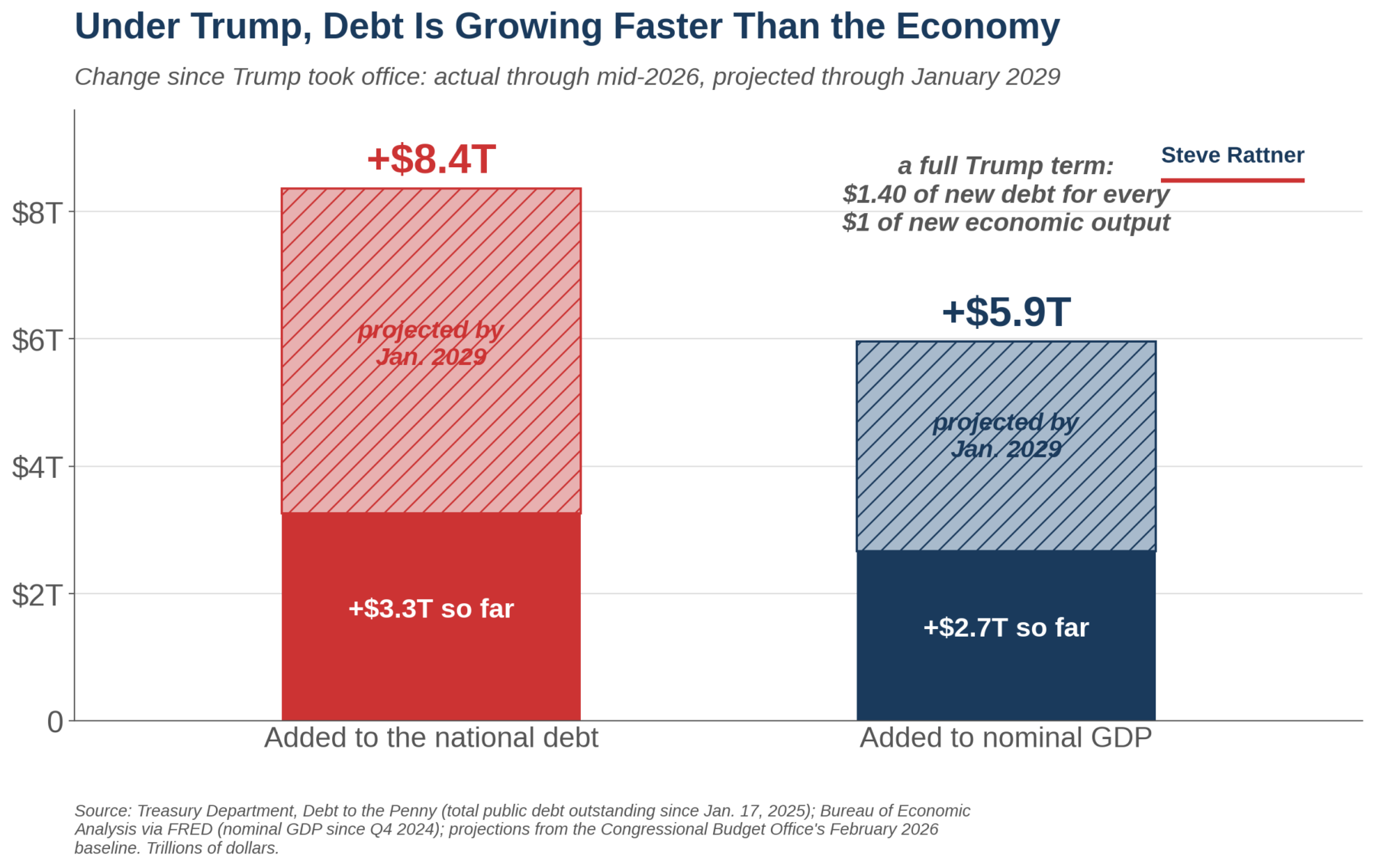
A big part of the reason is governments persistently borrowing to cover deficits, with no plan to reduce them. For example, the Trump administration has borrowed more than the growth in US GDP. Projections are that by the end of their term they will have borrowed $1.40 for every $1 growth in GDP. Half of that GDP growth is from the AI bubble. Remove it and the administration has already borrowed almost 2.5 times the GDP growth.

But another part of the reason is that governments are facing competition for the available funds from other highly-rated borrowers. Hyperscalers such as Microsoft (AAA) and Alphabet (AA+) can no longer pay cash for the immense sums they believe they need in order to keep up with their competitors in the race for AGI. So the bond market is facing a significant increase in demand, which naturally increases interest rates.

Below the fold I look into how this competition for funds is going.

Tuesday, September 8, 2026

EatingThe Seed Corn (Updated)

The Village Idiom explains:
In the idiom "eat one's seed corn", the phrase refers to consuming or disposing of valuable resources without considering the long-term consequences. It implies a short-sightedness and lack of foresight, often resulting in detrimental effects on future prospects or success.
Salomé Balthus
Uwe Hauth, CC BY-SA 4.0
More than a year ago in Going Out With A Bang I quoted Salomé Balthus:
'The elephant in the room is climate change. Everyone knows it can't be prevented any more,' she said, adding that the 'super rich' could generally be split into two groups on the topic.

'The one group thinks it only affects the poor, the "not-white race", while the others fear that it could get worse but there's no sense in trying to do anything about it so they just enjoy themselves,'
In fact both groups have decided to steal everything they can get their hands on to fund their retreat to bunkers on private islands protected by armed autonomous humanoid robots. Below the fold I look at yet another example of this trend.

Tuesday, September 1, 2026

Small Is Beautiful (Updated 2x)

Estimates are that, to justify the AI platforms' enormous capex plans, by 2030 they need to be generating around $2T/year in revenue. If every adult resident of the US spent $20/month on AI, it would generate $68.5B/year. Clearly, only the enterprise market stands even a remote possibility of generating the bulk of the $2T.

There are three major threats to the prospect of AI platforms extracting 6% of current US GDP from the enterprise market, and thus to OpenAI's and Anthropic's ambitions to IPO in the near future. First, faced with AI's Affordability Crisis, companies have been placing strict limits on employees' spending on AI tokens.

Source
Second, the gap in performance between expensive, closed-weight US models, such as OpenAI's and Anthropic's, and much cheaper, open-weight Chinese models has been rapidly closing, with the result that the US models are losing enterprise market share. Luz Ding, Spe Chen and Hayley Warren analyze this in US Lead in the AI Race With China Is Rapidly Narrowing:
Bloomberg in partnership with researchers at Vals AI, an independent AI evaluation and benchmarking platform, tested seven models from frontier Chinese and US companies to see how they performed in a real-world task. They were asked to create a fictional coffee e-commerce site called Brewberg using the same prompts. Most of the models scored 100% functional accuracy despite occasional design misses, but with very different price tags. The experiment employed the top performing models in July from Anthropic and all the Chinese firms, as well as more affordable models from OpenAI and Google.
They all did reasonably well, but the two best were Claude Fable 5 at $48.99 and Kimi K3 at $11.99. Chinese models charging much less for almost the same performance are grabbing market share:
the use of Chinese models overtook US platforms globally for the first time in June, and accounted for more than 60% of market share last month, on OpenRouter, a tech platform that offers software developers access to hundreds of AI models. It is a widely watched gauge of model usage despite tracking just a fraction of global AI consumption. The US, parts of Europe and Asia now favor Chinese labs, according to the same data.

On Hugging Face, Chinese AI models account for 41.4% of generative model downloads among developers, 5 percentage points higher than US models.
Third, it isn't just that the Chinese models are cheaper to run remotely, but also that because they are open-weight they can be run on affordable in-house systems, which means that:
  • They don't give Donald Trump a kill-switch for your busines.
  • They don't give Sam Altman or Dario Amodei a kill-switch for your busines.
  • They don't require giving the Chinese, Sam Altman or Dario Amodei all your business' critical data.
  • They provide visibility into and control over AI costs.
  • They are even cheaper.
The question is "compared to the closed-weight US models, what do you lose by running open-weight models in-house?" Below the fold I discuss a major study from Stanford that answers the question.

Tuesday, July 21, 2026

Distilling The Moat

Whisky Still
The original function of a Web server was to respond to queries by revealing the appropriate part of their internal data. This necessarily meant that repeated queries, for example from a search engine's or an internet archive's web crawler, could extract the server's entire internal data. Since the extracted data had been published on the Web, it was not trade secret. It was protected by the publisher's copyright. This has led to many lawsuits, for example against the Internet Archive, Google and others. It is the reason search engines only display "snippets" of the content they collect.

AI companies' intellectual property is their models. They spend vast sums funding the technical and human resources to "train" these models, the racks of GPUs in the data centers, and the hordes of workers labeling images, and having "genuine human conversations" with the nascent model. These expenditures are thought to create a "moat" around the value thus generated, because it would be equally expensive for a competitor to create an equivalent model. It is this moat that supports their extraordinary valuations, despite their lack of earnings.

Below the fold I explain why their moat is very shallow.

Tuesday, July 14, 2026

Portents Of Doom

Elon Musk is the world champion of totally implausible projections, and Kim Khan reported on a personal best in SpaceX sees total addressable market rivaling size of the U.S. economy:
The $28.5T forecast compares to U.S. Q1 2026 nominal GDP of nearly $32T, with the estimate for the market of AI enterprise applications of $22.7T about 70% of total U.S. economic output.
Sam Altman and Dario Amodei just aren't this good, but their projections of their Total Available Market (TAM) are still turning out to be vastly optimistic. In AI's Affordability Crisis I showed evidence that the AI platforms could no longer afford the massive subsidies they were using to artifically inflate demand for their product, and that reducing the subsidies had made their enterprise customers reconsider their enthusiasm for deploying them. This is leading to investors belatedly realizing that AI platforms' projections of their TAM and thus their valuations are totally implausible.

This re-calibration is just one of the many signs that the AI bubble is about to deflate. Below the fold I present a necessarily incomplete list of them, which I will try to update as more appear.

The Kelvin Limit

I have been a small part of the chorus of voices critiquing the AI bubble that I described in Portents Of Doom. But what if we're wrong? What if the overwhelming demand for AI sin't the result of the AI platforms massively subsidizing their products, but because the world needs more and more non-consensual sex images, slop web pages, agentic ransomware attacks, students cheating on exams, hallucinated lawsuits, and all the other benefits of this transformative technology?

Please suspend disbelief and follow me below the fold as I look into a fascinating examination of the implications of the exponential growth in the data centers needed to provide these benefits.

Tuesday, June 30, 2026

Coprophagia Is Bad For You

Divine, Pink Flamingos
Wikipedia defines Coprophagia as "the consumption of feces".

Since "brevity is the soul of wit", my favorite science fiction includes the 254 words of Fredric Brown's Answer from 1954. It describes a galactic civilization holding a ceremony to mark the final connection of all their computers. What happened was:
Dwar Ev threw the switch. There was a mighty hum, the surge of power from ninety-six billion planets. Lights flashed and quieted along the miles-long panel.

Dwar Ev stepped back and drew a deep breath. “The honor of asking the first question is yours, Dwar Reyn.”

“Thank you,” said Dwar Reyn. “It shall be a question that no single cybernetics machine has been able to answer.”

He turned to face the machine. “Is there a God?”

The mighty voice answered without hesitation, without the clicking of single relay.

“Yes, now there is a God.”

Sudden fear flashed on the face of Dwar Ev. He leaped to grab the switch.

A bolt of lightning from the cloudless sky struck him down and fused the switch shut.
This may have inspired Douglas Adams' similar but much longer scenario in which the answer turned out to be 42.

Below the fold I trace the connection between these two ideas.

Tuesday, June 23, 2026

AI's Affordability Crisis

A year ago in The Back Of The AI Envelope I pointed out that the AI platforms were running the drug-dealer's algorithm, "the first one's free". By massively subsidizing the use of their products, they were generating overwhelming demand for them. They used this demand to justify massive investments, in the hope that, by the time they had to show a return on these invetment, the users would be so addicted that they would pay the vastly higher prices needed to generate a return.

David Cahn, Sept '23
I have to confess that I was late to the party. The earliest skepticism I've been able to find was from Sequoia Capital's David Cahn in September 2023, entitled AI’s $200B Question. Only nine months later Cahn re-ran the same analysis in AI’s $600B Question. His estimate of the revenue gap had tripled. Cahn wasn't alone. Independent journalists such as Ed Zitron were flagging this problem long before I was.

I started to write this post a couple of months ago when the maiinstream business press began to notice companies complaining about the cost of the tokens their employees were burning. Since then the trickle has turned into a flood, which made finishing the post hard. Below the fold I throw up my hands and dump out a small sample from the flood.

Tuesday, June 16, 2026

Chatbots vs. Ozone

Source
Back in February I posted The Kessler Syndrome, which also included a brief section mentioning the impacts of the proposed megaconstellations on the environment, specifically global warming from CO2 and black carbon, and depletion of the ozone layer. Three months earlier Anton Petrov had examined the last of these in Risk of Ozone Layer Destruction from Internet Satellite Swarms and Rocket Fuel. He has now followed up with SpaceX Is Conducting a Giant Chemical Experiment on Our Atmosphere Without Realizing. Below the fold I survey the papers Petrov cited and a few others.

Tuesday, June 9, 2026

Library of Congress Storage Architecture Meeting 2026

Once again I attended most of the library of Congress' Designing Storage Architectures workshop remotely. I apologize for the delay in posting this; domestic duties have kept me very busy recently. Below the fold notes on the talks that caught my attention, based on my now somewhat memory and the slide decks for the talks from the Library of Congress website.

Tuesday, June 2, 2026

AI's PR Problem (Updated)

J.P. Morgan hits photographer with cane
This is just a brief post to explain to my old boss, Eric Schmidt, why he and his ilk are getting booed at college commencements, and why laws against data centers are getting passed. The explanation is below the fold.

Tuesday, May 19, 2026

Flooded Zones Part 2

Source
This is the promised follow-on to Flooded Zones Part 1, which discussed the Distributed Denial of Service (DDoS) attack being mounted by AI against the scholarly publication system. By reducing the cost of generating and submitting a paper or a review, AI has caused a massive increase in the quantity and a significant decrease in the quality of submissions to a system that was already vastly overloaded.

Below the fold I look at AI-enabled DDoS attacks against two other even more important areas; software security and political discourse (as shown in the overview image).

Friday, May 15, 2026

Flooded Zones Part 1

Tom Cowap
CC-BY-SA 4.0
Three years ago in Flooding The Zone With Shit, my first post on the AI bubble, I wrote:
My immediate reaction to the news of ChatGPT was to tell friends "at last, we have solved the Fermi Paradox". It wasn't that I feared being told "This mission is too important for me to allow you to jeopardize it", but rather that I assumed that civilizations across the galaxy evolved to be able to implement ChatGPT-like systems, which proceeded to irretrievably pollute their information environment, preventing any further progress.
The post title was a notorious quote from Steve Bannon. Below the fold, I look into scholarly publication, the first of three areas whose zones are currently being flooded with AI output in what can be considered DDoS (Distributed Denial of Service attacks:
A distributed denial-of-service (DDoS) attack occurs when multiple systems flood the bandwidth or resources of a targeted system, usually one or more web servers.
A subsequent post will examine two more flood zones, political discourse and software security.

Thursday, March 26, 2026

The Handoff Problem (Updated)

Source
Around twelve years ago, Google figured out the fundamental problem facing Tesla's Fake Self Driving. Almost nine years ago in Robot Cars Can’t Count on Us in an Emergency, John Markoff wrote:
Three years ago, Google’s self-driving car project abruptly shifted from designing a vehicle that would drive autonomously most of the time while occasionally requiring human oversight, to a slow-speed robot without a brake pedal, accelerator or steering wheel. In other words, human driving was no longer permitted.

The company made the decision after giving self-driving cars to Google employees for their work commutes and recording what the passengers did while the autonomous system did the driving. In-car cameras recorded employees climbing into the back seat, climbing out of an open car window, and even smooching while the car was in motion, according to two former Google engineers.
Gareth Corfield at The Register added:
Google binned its self-driving cars' "take over now, human!" feature because test drivers kept dozing off behind the wheel instead of watching the road, according to reports.

"What we found was pretty scary," Google Waymo's boss John Krafcik told Reuters reporters during a recent media tour of a Waymo testing facility. "It's hard to take over because they have lost contextual awareness."
Follow me below the fold for a wonderful example of Tesla's handoff problem, and a discussion of the difference between Tesla's and Waymo's approaches to self-driving.

Tuesday, March 3, 2026

Skynet Progress Report (updated)

Source
I, for one, welcome our new insect overlords
Kent Brockman in "Deep Space Homer", The Simpsons
In recent months Cyberdyne Systems Corporation and its many subsidiaries have made very encouraging progress towards removing some of the major road-blocks standing in the way of the initial deployment of Skynet. Below the fold I report on the most significant ones.