Friday, January 31, 2025

Paul Evan Peters Award

YearAwardee
2024Tony Hey
2022Paul Courant
2020Francine Berman
2017Herbert Van de Sompel
2014Donald A.B. Lindberg
2011Christine L. Borgman
2008Daniel E. Atkins
2006Paul Ginsparg
2004Brewster Kahle
2002Vinton Gray Cerf
2000Tim Berners-Lee
It has just been announced that at the Spring 2025 Membership Meeting of the Coalition for Networked Information in Milwaukee, WI April 7th and 8th, Vicky and I are to receive the Paul Evan Peters Award. The press release announcing the award is here.

Vicky and I are honored and astonished by this award. Honored because it is the premiere award in the field, and astonished because we left the field more than seven years ago to take up our new full-time career as grandparents. We are all the more astonished because we are not even eligible for the award; the rules clearly state that the "award will be granted to an individual".

You can tell this is an extraordinary honor from the list of previous awardees, and the fact that it is the first time it has been awarded in successive years. Vicky and I are extremely grateful to the Association of Research Libraries, CNI and EDUCAUSE, who sponsor the award.

Original Logo
Part of the award is the opportunity to make an extended presentation to open the meeting. The text of our talk, entitled Lessons From LOCKSS, with links to the sources and information that appeared on slides but was not spoken, should appear here on April 7th.

The work that the award recognizes was not ours alone, but the result of a decades-long effort by the entire LOCKSS team. It was made possible by support from the LOCKSS community and many others, including Michael Lesk then at NSF, Donald Waters then at the Mellon Foundation, the late Karen Hunter at Elsevier, Stanford's Michael Keller and CNI's Cliff Lynch.

Thursday, January 16, 2025

A Prophet Of The Web

While doing the research for a future talk, I came across an obscure but impressively prophetic report entitled Accessibility and Integrity of Networked Information Collections that Cliff Lynch wrote for the federal Office of Technology Assessment in 1993, 32 years ago. I say "obscure" because it doesn't appear in Lynch's pre-1997 bibliography.

To give you some idea of the context in which it was written, unless you are over 70, it was more than half your life ago when in November 1989 Tim Berners-Lee's browser first accessed a page from his Web server. It was only about the same time that the first commercial, as opposed to research, Internet Service Providers started with the ARPANET being decommissioned the next year. Two years later, in December of 1991, the Stanford Linear Accelerator Center put up the first US Web page. In 1992 Tim Berners-Lee codified and extended the HTTP protocol he had earlier implemented. It would be another two years before Netscape became the first browser to support HTTPS. It would be two years after that before the ITEF approved HTTP/1.0 in RFC 1945. As you can see, Lynch was writing among the birth-pangs of the Web.

Although Lynch was insufficiently pessimistic, he got a lot of things exactly right. Below the fold I provide four out of many examples.

Tuesday, January 7, 2025

Storage Roundup

It is time for another roundup of topics in storage that have caught my eye recently. Below the fold I discuss the possible ending of the HAMR saga and various developments in archival storage technology.

Tuesday, December 31, 2024

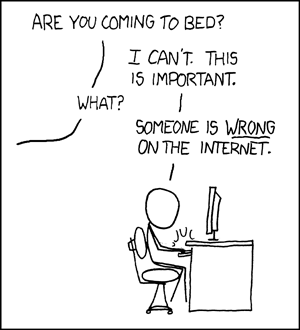
Self-Own

Credit: XKCD
The Cambridge dictionary defines the verb to bullshit as:
a rude word meaning to try to persuade someone or make them admire you by saying things that are not true
The essence of successful bullshit is that it should be both plausible and presented authoritatively. Bullshitters are always tempted to buttress the appearance of authority by including actual evidence rather than just their interpretation of the evidence, but this is often a fatal mistake. Below the fold I discuss a classic example from MAGA's campaign to demonize immigrants.

Tuesday, December 17, 2024

Cherry-picking

Source
Via Barry Ritholtz we find this infographic entitled Top Performing S&P 500 Stocks showing the best total return over the past 5, 10, 15 and 20 years. Ritholtz sourced it from Ranked: The Top Performing S&P 500 Stocks in the Last Two Decades By Marcus Lu with graphic design by Miranda Smith.

In each case, Nvidia is the best performing stock, and it is the only stock to appear in all four periods. Sounds great, doesn't it? Why wouldn't you just hold NVDA all the time and be guaranteed to beat the market?

But follow me below the fold for more detail from someone who has been long NVDA for more than three decades..

Tuesday, December 3, 2024

Drones

Fictional CEO demonstrates microdrone
Source
In 2017 the Future of Life Institute released a video entitled Slaughterbots. Wikipedia describes it as an:
arms-control advocacy video presenting a dramatized near-future scenario where swarms of inexpensive microdrones use artificial intelligence and facial recognition software to assassinate political opponents based on preprogrammed criteria.
War accelerates technological progress. The war in Ukraine has not yet produced "slaughterbots" but it has greatly accelerated drone technology and taken some giant steps toward them. The most important of these steps is that the cost of precision strike has been reduced by 1-2 orders of magnitude, making it affordable for "non-state actors" and even individuals.

Below the fold I look at drone developments in the war in Ukraine, what is happening with drones and drone defense in the West, and sketch some implications for the future.

Tuesday, November 19, 2024

Driver Distraction Technology

Not this hand-off
In the aftermath of the 737 MAX crashes, I wrote First We Change How People Behave.:
The fundamental problem of autonomous vehicles sharing roads is that until you get to Level 5, you have a hand-off problem. The closer you get to Level 5, the worse the hand-off problem.
Three years earlier, Paul Vixie was more specific in Disciplining the Unoccupied Mind:
Simply put, if you give a human brain the option to perform other tasks than the one at hand, it will do so. No law, no amount of training, and no insistence by the manufacturer of an automobile will alter this fact. It's human nature, immalleable. So until and unless Tesla can robustly and credibly promise an autopilot that will imagine every threat a human could imagine, and can use the same level of caution as the best human driver would use, then the world will be better off without this feature.
Follow me below the fold for an update on the hand-off problem.