
I started expressing my gradually increasing skepticism the following year. Now, nearly eleven years after Dave's talk, it is time to follow me below the fold for another update.
 |
| Source |
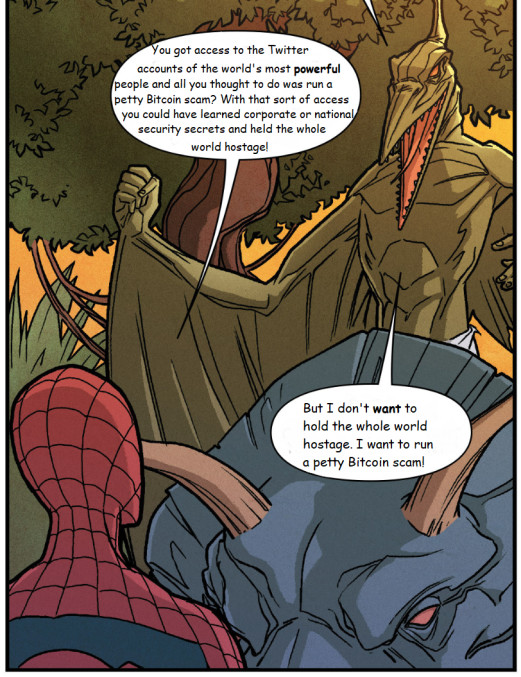
It was about 4 in the afternoon on Wednesday on the East Coast when chaos struck online. Dozens of the biggest names in America — including Joseph R. Biden Jr., Barack Obama, Kanye West, Bill Gates and Elon Musk — posted similar messages on Twitter: Send Bitcoin and the famous people would send back double your money.Two days later Nathaniel Popper and Kate Conger's Hackers Tell the Story of the Twitter Attack From the Inside was based on interviews with some of the perpetrators:
Mr. O'Connor said other hackers had informed him that Kirk got access to the Twitter credentials when he found a way into Twitter’s internal Slack messaging channel and saw them posted there, along with a service that gave him access to the company’s servers. People investigating the case said that was consistent with what they had learned so far. A Twitter spokesman declined to comment, citing the active investigation.Below the fold, some commentary on this and other stories of the fiasco.
All over this blog (e.g. here) you will find references to W. Brian Arthur's Increasing Returns and Path Dependence in the Economy because it pointed out the driving forces, often called network effects, that cause technology markets to be dominated by one, or at most a few, large players. This is a problem for digital preservation, and for society in general, for both economic and technical reasons. The economic reason is that these natural but unregulated monopolies extract rents from their customers. The technical reason is that they make the systems upon which society depends brittle, subject to sudden, catastrophic and hard-to-recover-from failures.Now, the pandemic has inspired two writers to address the bigger version of the same problem, Bruce Schneier in The Security Value of Inefficiency and Jonathan Aldred in This pandemic has exposed the uselessness of orthodox economics. Below the fold, some commentary.

Our findings on the estimated revenue from transaction fees are in line with the widespread opinion that participation is economically irrational for the majority of the large routing nodes who currently hold the network together. Either traffic or transaction fees must increase by orders of magnitude to make payment routing economically viable.Below the fold I comment on their latest work.
Two major study retractions in one month have left researchers wondering if the peer review process is broken.Below the fold I explain that the researchers who are only now "wondering if the peer review process is broken" must have been asleep for more than the last decade.
open-source software is fully integrated into Google’s Android phones. The volunteer labor of thousands thus helps power Google’s surveillance-capitalist machine.Below the fold, I discuss "the volunteer labor of thousands".
